
Boards
Produkte filtern

Uno The UNO is the best board to get started with electronics and coding. If this is your first experience tinkering with the platform, the UNO is the most robust board you can start playing with. The UNO is the most used and documented board of the whole Arduino family. Produktübersicht Arduino Uno is a microcontroller board based on the ATmega328P (datasheet). It has 14 digital input/output pins (of which 6 can be used as PWM outputs), 6 analog inputs, a 16 MHz quartz crystal, a USB connection, a power jack, an ICSP header and a reset button. It contains everything needed to support the microcontroller; simply connect it to a computer with a USB cable or power it with a AC-to-DC adapter or battery to get started.. You can tinker with your UNO without worring too much about doing something wrong, worst case scenario you can replace the chip for a few dollars and start over again. "Uno" means one in Italian and was chosen to mark the release of Arduino Software (IDE) 1.0. The Uno board and version 1.0 of Arduino Software (IDE) were the reference versions of Arduino, now evolved to newer releases. The Uno board is the first in a series of USB Arduino boards, and the reference model for the Arduino platform; for an extensive list of current, past or outdated boards see the Arduino index of boards. Technische Spezifikationen Microcontroller ATmega328P Operating Voltage 5V Input Voltage (recommended) 7-12V Input Voltage (limit) 6-20V Digital I/O Pins 14 (of which 6 provide PWM output) PWM Digital I/O Pins 6 Analog Input Pins 6 DC Current per I/O Pin 20 mA DC Current for 3.3V Pin 50 mA Flash Memory 32 KB (ATmega328P) of which 0.5 KB used by bootloader SRAM 2 KB (ATmega328P) EEPROM 1 KB (ATmega328P) Clock Speed 16 MHz LED_BUILTIN 13 Length 68.6 mm Width 53.4 mm Weight 25 g
Sofort verfügbar, Lieferzeit: 1-2 Tage

Mega 2560 The MEGA 2560 is designed for more complex projects. With 54 digital I/O pins, 16 analog inputs and a larger space for your sketch it is the recommended board for 3D printers and robotics projects. This gives your projects plenty of room and opportunities. Produktübersicht The Arduino Mega 2560 is a microcontroller board based on the ATmega2560. It has 54 digital input/output pins (of which 15 can be used as PWM outputs), 16 analog inputs, 4 UARTs (hardware serial ports), a 16 MHz crystal oscillator, a USB connection, a power jack, an ICSP header, and a reset button. It contains everything needed to support the microcontroller; simply connect it to a computer with a USB cable or power it with a AC-to-DC adapter or battery to get started. The Mega 2560 board is compatible with most shields designed for the Uno and the former boards Duemilanove or Diecimila. The Mega 2560 is an update to the Arduino Mega, which it replaces. Technische Spezifikationen Microcontroller ATmega2560 Operating Voltage 5V Input Voltage (recommended) 7-12V Input Voltage (limit) 6-20V Digital I/O Pins 54 (of which 15 provide PWM output) Analog Input Pins 16 DC Current per I/O Pin 20 mA DC Current for 3.3V Pin 50 mA Flash Memory 256 KB of which 8 KB used by bootloader SRAM 8 KB EEPROM 4 KB Clock Speed 16 MHz LED_BUILTIN 13 Length 101.52 mm Width 53.3 mm Weight 37 g
Sofort verfügbar, Lieferzeit: 1-2 Tage

Nano The Arduino Nano is a compact board similar to the UNO. Produktübersicht The Arduino Nano is a small, complete, and breadboard-friendly board based on the ATmega328 (Arduino Nano 3.x). It has more or less the same functionality of the Arduino Duemilanove, but in a different package. It lacks only a DC power jack, and works with a Mini-B USB cable instead of a standard one. Technische Spezifikationen Microcontroller ATmega328 Architecture AVR Operating Voltage 5 V Flash Memory 32 KB of which 2 KB used by bootloader SRAM 2 KB Clock Speed 16 MHz Analog IN Pins 8 EEPROM 1 KB DC Current per I/O Pins 40 mA (I/O Pins) Input Voltage 7-12 V Digital I/O Pins 22 (6 of which are PWM) PWM Output 6 Power Consumption 19 mA PCB Size 18 x 45 mm Weight 7 g Product Code A000005
Sofort verfügbar, Lieferzeit: 1-2 Tage

Uno SMD The board everybody gets started with, based on the ATmega328 (SMD). Produktübersicht The Arduino Uno SMD R3 is a microcontroller board based on the ATmega328. It has 14 digital input/output pins (of which 6 can be used as PWM outputs), 6 analog inputs, a 16 MHz crystal oscillator, a USB connection, a power jack, an ICSP header, and a reset button. It contains everything needed to support the microcontroller; simply connect it to a computer with a USB cable or power it with a AC-to-DC adapter or battery to get started. The Uno differs from all preceding boards in that it does not use the FTDI USB-to-serial driver chip. Additional features coming with the R3 version are: - ATmega16U2 instead 8U2 as USB-to-Serial converter. - 1.0 pinout: added SDA and SCL pins for TWI communication placed near to the AREF pin and two other new pins placed near to the RESET pin, the IOREF that allow the shields to adapt to the voltage provided from the board and the second one is a not connected pin, that is reserved for future purposes. - stronger RESET circuit. "Uno" means "One" in Italian and is named to mark the upcoming release of Arduino 1.0. The Uno and version 1.0 will be the reference versions of Arduino, moving forward. The Uno is the latest in a series of USB Arduino boards, and the reference model for the Arduino platform. Technische Spezifikationen Microcontroller ATmega328P Operating Voltage 5V Input Voltage (recommended) 7-12V Input Voltage (limit) 6-20V Digital I/O Pins 14 (of which 6 provide PWM output) PWM Digital I/O Pins 6 Analog Input Pins 6 DC Current per I/O Pin 20 mA DC Current for 3.3V Pin 50 mA Flash Memory 32 KB (ATmega328P) of which 0.5 KB used by bootloader SRAM 2 KB (ATmega328P) EEPROM 1 KB (ATmega328P) Clock Speed 16 MHz LED_BUILTIN 13 Length 68.6 mm Width 53.4 mm Weight 25 g
Sofort verfügbar, Lieferzeit: 1-2 Tage

Micro Arduino Micro is the smallest board of the family, easy to integrate it in everyday objects to make them interactive. The Micro is based on the ATmega32U4 microcontroller featuring a built-in USB which makes the Micro recognisable as a mouse or keyboard. Produktübersicht The Micro is a microcontroller board based on the ATmega32U4 (datasheet), developed in conjunction with Adafruit. It has 20 digital input/output pins (of which 7 can be used as PWM outputs and 12 as analog inputs), a 16 MHz crystal oscillator, a micro USB connection, an ICSP header, and a reset button. It contains everything needed to support the microcontroller; simply connect it to a computer with a micro USB cable to get started. It has a form factor that enables it to be easily placed on a breadboard. The Micro board is similar to the Arduino Leonardo in that the ATmega32U4 has built-in USB communication, eliminating the need for a secondary processor. This allows the Micro to appear to a connected computer as a mouse and keyboard, in addition to a virtual (CDC) serial / COM port. It also has other implications for the behavior of the board; these are detailed on the getting started page. Technische Spezifikationen Microcontroller ATmega32U4 Operating Voltage 5V Input Voltage (recommended) 7-12V Input Voltage (limit) 6-20V Digital I/O Pins 20 PWM Channels 7 Analog Input Channels 12 DC Current per I/O Pin 20 mA DC Current for 3.3V Pin 50 mA Flash Memory 32 KB (ATmega32U4) of which 4 KB used by bootloader SRAM 2.5 KB (ATmega32U4) EEPROM 1 KB (ATmega32U4) Clock Speed 16 MHz LED_BUILTIN 13 Length 48 mm Width 18 mm Weight 13 g
Sofort verfügbar, Lieferzeit: 1-2 Tage

Leonardo Similar to an Arduino UNO, can be recognized by computer as a mouse or keyboard. Produktübersicht The Arduino Leonardo is a microcontroller board based on the ATmega32u4 (datasheet). It has 20 digital input/output pins (of which 7 can be used as PWM outputs and 12 as analog inputs), a 16 MHz crystal oscillator, a micro USB connection, a power jack, an ICSP header, and a reset button. It contains everything needed to support the microcontroller; simply connect it to a computer with a USB cable or power it with a AC-to-DC adapter or battery to get started. The Leonardo differs from all preceding boards in that the ATmega32u4 has built-in USB communication, eliminating the need for a secondary processor. This allows the Leonardo to appear to a connected computer as a mouse and keyboard, in addition to a virtual (CDC) serial / COM port. It also has other implications for the behavior of the board; these are detailed on the getting started page. Technische Spezifikationen Microcontroller ATmega32u4 Operating Voltage 5V Input Voltage (Recommended) 7-12V Input Voltage (limits) 6-20V Digital I/O Pins 20 PWM Channels 7 Analog Input Channels 12 DC Current per I/O Pin 40 mA DC Current for 3.3V Pin 50 mA Flash Memory 32 KB (ATmega32u4) of which 4 KB used by bootloader SRAM 2.5 KB (ATmega32u4) EEPROM 1 KB (ATmega32u4) Clock Speed 16 MHz Lenght 68.6 mm Width 53.3 mm Weight 20 g
Sofort verfügbar, Lieferzeit: 1-2 Tage

WLAN! Möchten Sie Ihren Geräten eine WiFi-Schnittstelle hinzufügen? Holen Sie sich das MKR WIFI 1010! Es lässt sich problemlos mit anderen Arduino-Produkten verbinden und ist mit der Arduino-Software konfigurierbar - und Sie müssen kein Netzwerkexperte sein. Dies ist die neueste Version des MKR 1000 WIFI, jedoch mit einem ESP32-Modul von U-BLOX an Bord. Arduino® MKR WiFi 1010 Der MKR WIFI 1010 ist eine deutliche Verbesserung gegenüber dem MKR 1000 WIFI. Er ist mit einem ESP32-Modul von U-BLOX ausgestattet. Dieses Board zielt darauf ab, das Prototyping von WiFi-basierten IoT-Anwendungen dank der Flexibilität des ESP32-Moduls und seines geringen Stromverbrauchs zu beschleunigen und zu vereinfachen. Technische Spezifikationen Microcontroller SAMD21 Cortex-M0+ 32bit Low Power ARM MCU Board Power Supply (USB/VIN) 5V Supported Battery(*) Li-Po Single Cell, 3.7V, 700mAh Minimum Circuit Operating Voltage 3.3V Digital I/O Pins 8 PWM Pins 12 (0, 1, 2, 3, 4, 5, 6, 7, 8, 10, A3 - or 18 -, A4 -or 19) UART 1 SPI 1 I2C 1 I2S 1 Connectivity WiFi Analog Input Pins 7 (ADC 8/10/12 bit) Analog Output Pins 1 (DAC 10 bit) External Interrupts 8 (0, 1, 4, 5, 6, 7, 8, A1 -or 16-, A2 - or 17) DC Current per I/O Pin 7 mA Flash Memory 256 KB SRAM 32 KB EEPROM No Clock Speed 32.768 kHz (RTC), 48 MHz LED_BUILTIN 6 Full-Speed USB Device and Embedded Host Included LED_BUILTIN 6 Length 61.5 mm Width 25 mm Weight 32 gr.
Sofort verfügbar, Lieferzeit: 1-2 Tage

4duino Board Nano v3 (kompatibel zu Arduino™ Nano v3) Mini-Version mit ATMEGA328P. Lieferung ohne Kabel. D-3 (A4)
Sofort verfügbar, Lieferzeit: 1-2 Tage
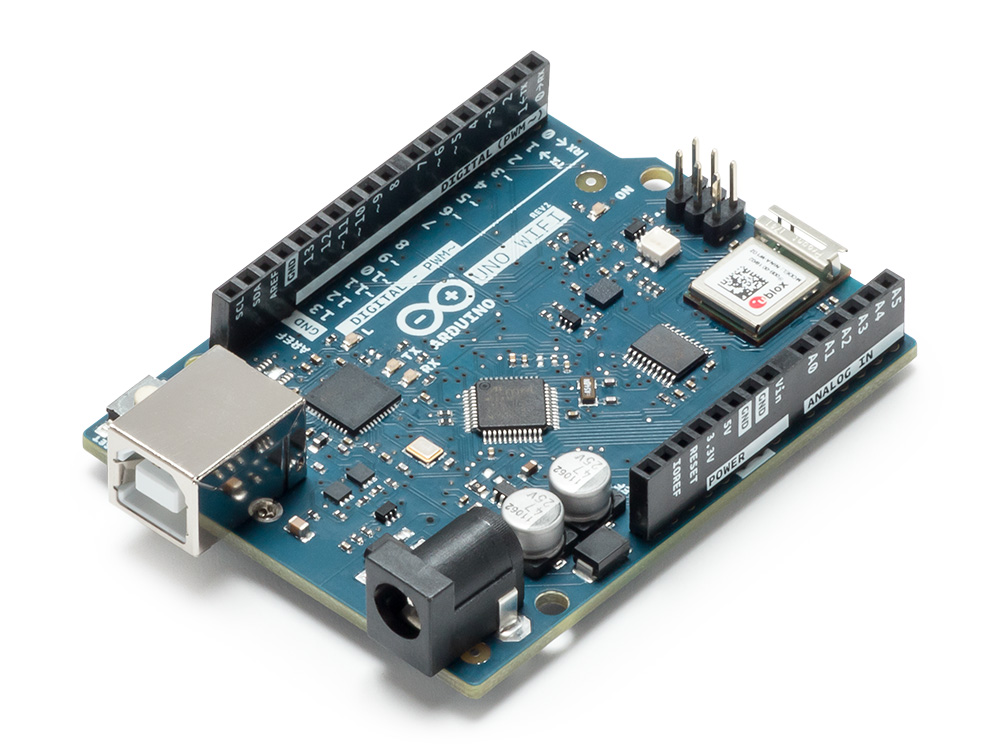
Übersicht Der Arduino UNO WiFi Rev.2 ist der einfachste Einstieg in das IoT mit dem Standard-Formfaktor der UNO-Familie. Egal, ob Sie ein Sensornetzwerk aufbauen wollen, das mit Ihrem Router im Büro oder zu Hause verbunden ist, oder ob Sie ein BLE-Gerät erstellen wollen, das Daten an ein Mobiltelefon sendet, das Arduino UNO WiFi Rev.2 ist Ihre Komplettlösung für viele der grundlegenden IoT-Anwendungsszenarien. Fügen Sie dieses Board zu einem Gerät hinzu und Sie können es mit einem WiFi-Netzwerk verbinden, indem Sie seinen sicheren ECC608 Krypto-Chip-Beschleuniger verwenden. Der Arduino Uno WiFi ist funktionell identisch mit dem Arduino Uno Rev3, verfügt aber zusätzlich über WiFi/Bluetooth und einige andere Verbesserungen. Es enthält den brandneuen ATmega4809 8-Bit-Mikrocontroller von Microchip und verfügt über eine Onboard-IMU (Inertial Measurement Unit) LSM6DS3TR. Das Wi-Fi-Modul ist ein eigenständiger SoC mit integriertem TCP/IP-Protokollstack, der den Zugang zu einem Wi-Fi-Netzwerk ermöglicht oder als Access Point fungiert. Es ist das u-blox NINA-W102 und (hier) finden Sie das Datenblatt. Der Arduino UNO WiFi Rev.2 hat 14 digitale Eingangs-/Ausgangs-Pins - 5 können als PWM-Ausgänge verwendet werden - 6 analoge Eingänge, einen USB-Anschluss, eine Stromversorgungsbuchse, einen ICSP-Header und einen Reset-Knopf. Er enthält alles, was zur Unterstützung des Mikrocontrollers benötigt wird. Schließen Sie ihn einfach mit einem USB-Kabel an einen Computer an oder versorgen Sie ihn mit einem Netzadapter oder einer Batterie, um loszulegen. Kompatibilität Dieses Board hat den Microchip ATmega4809 Mikrocontroller, aber dank der Kompatibilitätsschicht, die im Kern enthalten ist, können Sie alle Sketches, die für den ATmega328P Mikrocontroller der UNO gemacht wurden, auf dem ATmega4809 ausführen. Weitere Informationen über die Verwendung dieses Modus finden Sie auf der Seite Getting Started des Arduino UNO WiFi Rev.2. Bluetooth® und BLE Der Kommunikations-Chipsatz des Arduino UNO WiFi Rev.2 kann sowohl ein BLE- und Bluetooth®-Client als auch ein Host-Gerät sein. Das ist ziemlich einzigartig in der Welt der Mikrocontroller-Plattformen. Wenn Sie sehen möchten, wie einfach es ist, eine Bluetooth®-Zentrale oder ein Peripheriegerät zu erstellen, sehen Sie sich die Beispiele in der ArduinoBLE-Bibliothek an.
Nicht Lagernd

Small, powerful, BT connected and with all the sensors you may need to design innovative applications. This compact and reliable Nano board is built around the NINA B306 module for BLE and Bluetooth 5 communication; the module is based on Nordic nRF 52840 processor that contains a powerful Cortex M4F and the board has a rich set of sensors that allow the creation of innovative and highly interactive designs. Its architecture, fully compatible with Arduino IDE Online and Offline, has a 9 axis Inertial Measurement Unit (IMU), temperature, pressure, humidity, light, color and even gestures sensors and a microphone that are managed through our specialised libraries. Its reduced power consumption, compared to other same size boards, together with the Nano form factor opens up a wide range of applications. This allows the design of wearable devices and gesture based projects that need to communicate to other devices at a close range. Arduino Nano 33 BLE Sense is ideal for interactive automation projects thanks to the multiprotocol BT 5.0 radio. With headers mounted.
Sofort verfügbar, Lieferzeit: 1-2 Tage
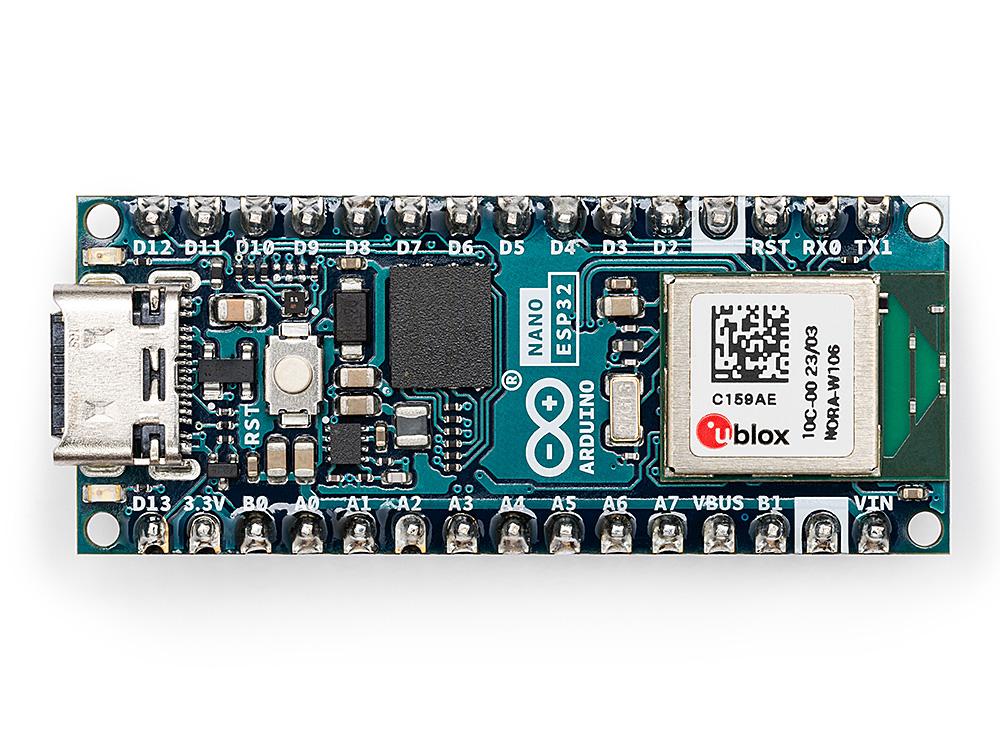
Arduino® Nano ESP32 WITH HEADERS Dieses Board bietet die ganze Leistung des bekannten ESP32-S3 mit der vollständigen Integration des Arduino-Ökosystems und ermöglicht es den Entwicklern, die Welt von Arduino und MicroPython ohne Einschränkungen zu erkunden. Lassen Sie Ihrer Kreativität freien Lauf und beginnen Sie mit dem Bau Ihres nächsten IoT-Projekts. Merkmale Arduino® Nano ESP32: Formfaktor des bekannten Arduino® Nano-Formfaktor und PIN kompatibel. Wi-Fi® und Bluetooth® on Borad: Nutzen Sie die Leistung des im IoT-Bereich bekannten ESP32-S3-Mikrocontrollers mit vollständiger Arduino-Unterstützung für drahtlose und Bluetooth®-Konnektivität. Arduino- und MicroPython-Unterstützung: Wechseln Sie nahtlos zwischen Arduino- und MicroPython-Programmierung mit ein paar einfachen Schritten. Arduino IoT Cloud-kompatibel: Erstellen Sie schnell und einfach IoT-Projekte mit nur ein paar Zeilen Code. Unser Setup kümmert sich um die Sicherheit und ermöglicht es Ihnen, Ihr Projekt von überall aus mit der Arduino IoT Cloud App zu überwachen und zu steuern. (Verfügbar ab August 2023) HID-Unterstützung: Emulieren Sie Geräte mit menschlicher Schnittstelle, wie Tastaturen oder Mäuse, über USB und eröffnen Sie sich so neue Möglichkeiten der Interaktion mit Ihrem Computer. Es gibt keine Ausreden mehr, um Ihre Erkundung von IoT und MicroPython aufzuschieben. Der Nano ESP32 bietet alles, was Sie brauchen, um mit der Entwicklung zu beginnen und die endlosen Möglichkeiten zu entdecken.
Nicht Lagernd

4duino Mega 2560 R3 inkl. USB Kabel (kompatibel zu Arduino™ Mega 2560 R3) D-8 (A2)
Nicht Lagernd
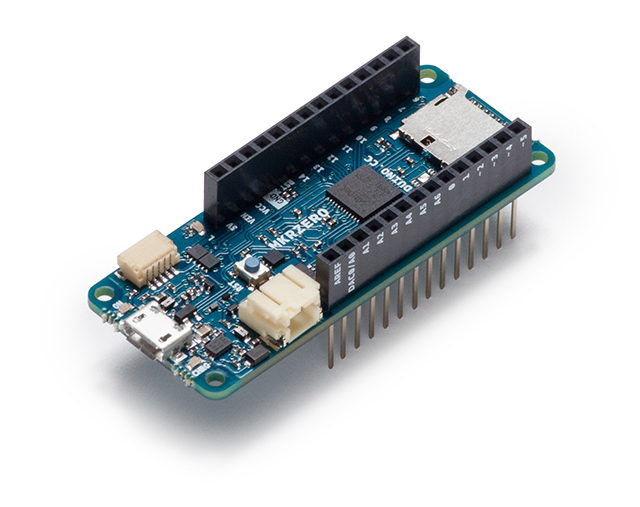
I2S Bus & SD! MKR ZERO hat einen integrierten SD-Anschluss mit speziellen SPI-Schnittstellen (SPI1), mit dem Sie ohne zusätzliche Hardware mit Musik Files herumspielen können! Für diejenigen, die es nicht wissen, ist I2S (Inter-IC Sound) ein elektrischer serieller Bus-Schnittstellenstandard für den Anschluss digitaler Audiogeräte. Achtung Musiker: wir haben ein paar Neuigkeiten für Sie! Wir haben zwei Bibliotheken für Sie freigegeben: - Arduino Sound Library - eine einfache Möglichkeit, Audiodaten mit Arduino auf SAM D21-basierten Boards abzuspielen und zu analysieren. - I2S-Bibliothek - zur Verwendung des I2S-Protokolls auf SAMD21-basierten Boards. Arduino® MKR Zero Der MKR ZERO bietet Ihnen die Leistung eines Arduino Zero im kleineren Format, das durch den MKR-Formfaktor festgelegt ist. Das MKR ZERO Board ist ein großartiges Lehrmittel, um mehr über die Entwicklung von 32-Bit-Anwendungen zu erfahren. Es verfügt über einen integrierten SD-Anschluss mit speziellen SPI-Schnittstellen (SPI1), mit dem Sie ohne zusätzliche Hardware mit MUSIC-Dateien spielen können! Das Board wird von Atmels SAMD21 MCU mit einem 32-Bit ARM Cortex® M0+ Kern betrieben. Technische Spezifikationen Microcontroller SAMD21 Cortex-M0+ 32bit low power ARM MCU Board Power Supply (USB/VIN) 5V Supported Battery(*) Li-Po single cell, 3.7V, 700mAh minimum DC Current for 3.3V Pin 600mA DC Current for 5V Pin 600mA Circuit Operating Voltage 3.3V Digital I/O Pins 22 PWM Pins 12 (0, 1, 2, 3, 4, 5, 6, 7, 8, 10, A3 - or 18 -, A4 -or 19) UART 1 SPI 1 I2C 1 Analog Input Pins 7 (ADC 8/10/12 bit) Analog Output Pins 1 (DAC 10 bit) External Interrupts 8 (0, 1, 4, 5, 6, 7, 8, A1 -or 16-, A2 - or 17) DC Current per I/O Pin 7 mA Flash Memory 256 KB Flash Memory for Bootloader 8 KB SRAM 32 KB EEPROM no Clock Speed 32.768 kHz (RTC), 48 MHz LED_BUILTIN 32 Full-Speed USB Device and embedded Host
Sofort verfügbar, Lieferzeit: 1-2 Tage
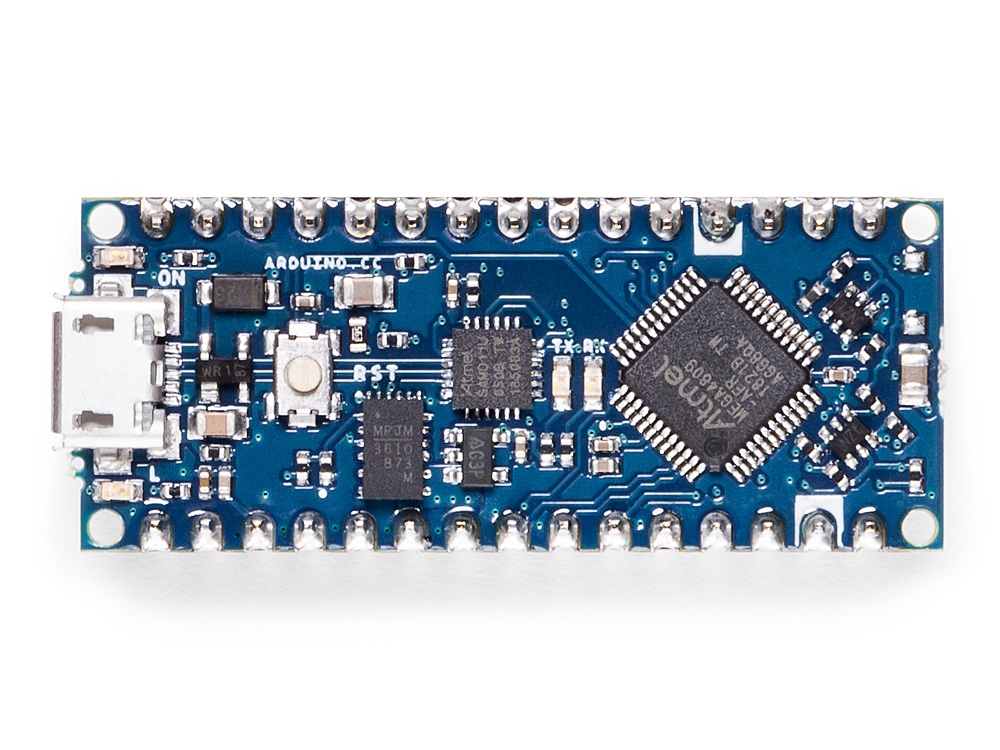
Turn your ideas into a reality quickly with the new Arduino Nano Every. This small, robust and powerful board has the same classic Nano footprint loved worldwide. It can be programmed with the easy to use Arduino IDE available offline and online. Get started in minutes with thousands of sketches available in open-source or write your own: it is the perfect choice for your everyday projects. Based on the ATMega4809 AVR processor, the Arduino Nano Every is flexible to the requirements of your design. It can be used in a breadboard when mounting pin headers, or as a SMT directly soldered on a PCB thanks to its castellated pads. An SAMD11 ARM Cortex M0+ processor acts as a high performance USB to serial converter that can be re-programmed by skilled users to expand further the applications of this board. With headers mounted.
Sofort verfügbar, Lieferzeit: 1-2 Tage

The ease of use of a Nano board with the addition of secure IoT and BT connectivity. This small, robust and powerful board has WiFi and Bluetooth connectivity that combined with its low power architecture makes it a practical and cost effective solution for your connected projects. Arduino Nano 33 IoT is fully compatible with the Arduino IoT Cloud and supports full TLS secure transport: the ATECC608A cryptochip stores the cryptographic keys in The ease of use of a Nano board with the addition of secure IoT and BT connectivity. This small, robust and powerful board has WiFi and Bluetooth connectivity that combined with its low power architecture makes it a practical and cost effective solution for your connected projects. Arduino Nano 33 IoT is fully compatible with the Arduino IoT Cloud and supports full TLS secure transport: the ATECC608A cryptochip stores the cryptographic keys in hardware, offering a very high level of security for this class of products. The integration with the Arduino IoT Cloud offers also a very efficient way of setting up online dashboards with little coding and minimal effort . In the same iconic size of the Arduino Nano, the Arduino Nano 33 IoT hosts an Arm Cortex-M0+ SAMD21 processor, a WiFi and Bluetooth module based on ESP32, a 6 axis Inertial Measurement Unit (IMU) and a crypto chip which can securely store certificates and pre shared keys. The board can either be used in a breadboard (when mounting pin headers), or as a SMT module, directly soldering it via the castellated pads. With headers mounted.
Sofort verfügbar, Lieferzeit: 1-2 Tage

4duino Uno R3 inkl. USB Kabel (komatibel zu Arduino™ Uno R3) Touch Screen Expansion Borad 2.4" (6,1cm) D-39 (A34)
Sofort verfügbar, Lieferzeit: 1-2 Tage

4duino Mega 2560 R3 inkl. USB Kabel Touch Screen Expansion Board 3.2" (8,13cm) D-38 (A35). (kompatibel zu Arduino™ Mega 2560 R3)
Sofort verfügbar, Lieferzeit: 1-2 Tage

4duino mega sensor Shield V1.2 with Xbee APC bluetooth port SD port Ideal, um mehrere Sensoren an einen Arduino™ Mega 1280/2560 anzuschließen. Das Board hat einen eigenen Stromanschluss zur Versorgung der angeschlossenen Module und die Ports haben jeweils eigene Masse- und Betriebsspannungsanschlüsse. Zusätzliche Steckleisten zur Aufnahme eines Xbee-Moduls vorhanden. D-18 (A26)
Sofort verfügbar, Lieferzeit: 1-2 Tage

Turn your ideas into a reality quickly with the new Arduino Nano Every. This small, robust and powerful board has the same classic Nano footprint loved worldwide. It can be programmed with the easy to use Arduino IDE available offline and online. Get started in minutes with thousands of sketches available in open-source or write your own: it is the perfect choice for your everyday projects. Based on the ATMega4809 AVR processor, the Arduino Nano Every is flexible to the requirements of your design. It can be used in a breadboard when mounting pin headers, or as a SMT directly soldered on a PCB thanks to its castellated pads. An SAMD11 ARM Cortex M0+ processor acts as a high performance USB to serial converter that can be re-programmed by skilled users to expand further the applications of this board.
Sofort verfügbar, Lieferzeit: 1-2 Tage

4duino sensor extended edition V4 Description Each functional module has buckled port with VCC, GND and Output, which has corresponding port on the Sensor Shield, connected with a plain 2.54mm dual-female cable you may start playing already. Buckled brick cables are like cement for bricks, make the connections easier, secure and more professional looking. Sensor Shield V4.0 allows you to connect to various modules like sensors, servos, relays, buttons, potentiometers.just plug & play! Each functional module has buckled port with VCC, GND and Output, which has corresponding port on the Sensor Shield, connected with a plain 2.54mm dual-female cable you may start playing already. Buckled brick cables are like cement for bricks, make the connections easier, secure and more professional looking. Operating Voltage: 5VDC Input Voltage (recommended): 7-12VDC Input Voltage (limits): 6-20VDC Buckled Analog Port:Handy, solid connection to 6 Analog inputs with VCC/GND Digital IO port:13 ports prepared to digital modules or servos Analog IO Port:2.54 grid male pin header connections Buckled Communication Port:Selectable between I2C and UART Compatible with: Arduino Duemilanove UNO Mega2560 ATMEL Specification: just plug & play Operating Voltage: 5VDC Input Voltage (recommended): 7-12VDC Input Voltage (limits): 6-20VDC Buckled Analog Port : solid connection to 6 Analog inputs with VCC/GND. Digital IO port : 13 ports prepared to digital modules or servos. Analog IO Port:2.54 grid male pin header connections. Buckled Communication Port : Selectable between I2C and UARt. Size:7cm x 5.8cm (2.76inch x 2.28inch)
Sofort verfügbar, Lieferzeit: 1-2 Tage

4duimo sensor extended edition V5 D-14 (A22)
Sofort verfügbar, Lieferzeit: 1-2 Tage

Der Primo ist der erste Arduino-Board mit einem Nordic nRF52 Prozessor mit WiFi gekennzeichnet. Das Arduino Primo kombiniert die Rechenleistung aus dem Nordic nRF52 Prozessor, einem Espressif ESP8266 für WiFi, sowie mehrere On-Board-Sensoren und ein Batterieladegerät . Die nRF52 umfasst NFC (Near Field Communication) und Bluetooth Smart. Die Sensoren umfassen eine On-Board-Taste, LED und Infrarot-Empfänger und Sender. Das Arduino Primo Core ist in Zusammenarbeit mit Nordic Semiconductor für den Bereich IoT entwickelt worden und ist durch seinen geringen Stromverbrauch und der Bluetoothfähigkeit ideal für Wearables-Projekte geeignet. Der verwendete Mikrocontroller ist ein nRF52832. Dieser wird auch auf dem Arduino Primo verwendet. Spezifikationen: 10 digitale Ein- / Ausgangspins 10 PWM (alle digitalen Pins) 8 analoge Pins (von D0 bis D7) Beschleunigungsmesser und Gyroskop Temperatur- und Feuchtigkeitssensor RGB Led SWD-Anschluss (zur Programmierung des Boards über einen externen Programmer) Ein Knopfzellen-Batteriehalter BLE-Schnittstelle LED NFC-Anschluss (zur Verwendung einer externen NFC-Antenne) Reset-Tasten (zum Zurücksetzen des Mikrocontrollers) Ein / Aus-Schalter für die Stromversorgung Dokumente: Anleitung Arduino PRIMO CORE Schematik WIFI MICROCONTROLLER Processor ESP8266 Architecture Tensilica Xtensa LX106 Operating Voltage 3.3 V Flash Memory 4 MB RAM 8 MB instruction, 12 MB data Clock Speed 80 MHz WiFi 802.11 b/g/n 2.4 GHz Wake up time < 2ms ARDUINO MICROCONTROLLER Microcontroller Nordic nRF52832 Architecture ARM Cortex-M4F Operating Voltage 3.3 V Flash memory 512 KB SRAM 64 KB Clock Speed 64 MHz Analog I/O Pins 6 + 1 DAC DC Current per I/O Pins 7 mA Bluetooth Smart Up to +4 dBm output power, -96 dBm sensitivity Other features PDM interface, AES HW enc, NFC tag SERVICE MICROCONTROLLER Processor STM32F103R8T6 Architecture ARM Cortex-M3 Operating Voltage 2.0 to 3.6 V Flash Memory 64 KB SRAM 20 KB Clock Speed up to 72 MHz Main Features USB/Uart converter, CMSIS-DAP, GPIO expander, Board power management, IrDA GENERAL Input Voltage 5 V Digital I/O Pins 20 PWM Output 3 Power Consumption 87 mA PCB Size 53 x 68.5 mm Weight 34 g Product Code A000135
Sofort verfügbar, Lieferzeit: 1-2 Tage
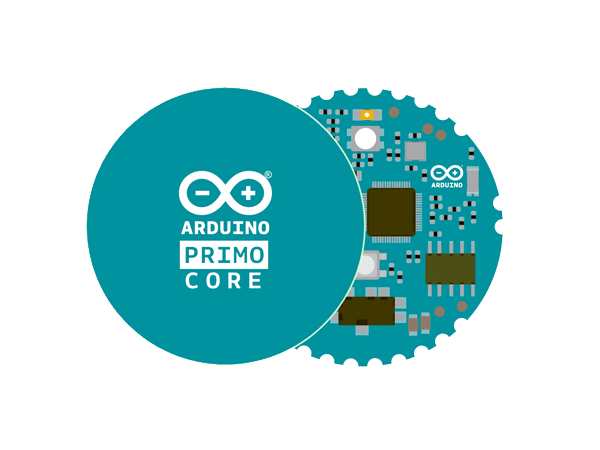
Der Primo Core ist der kleine Bruder des Primo mit einem Nordic nRF52 Prozessor. Der Primo Core ist eine Low-Power Version des Primo auf Münzgröße, ideal für Wearables. Der Primo Core ist ein kompaktes Bluetooth-Gerät, mit einem Nordic nrf52832 Chip und mit Motion- und Umweltsensoren. Der geringe Stromverbrauch ermöglicht es, den Primo-Kern mit einer Knopfzellenbatterie mit Strom zu versorgen. Der Arduino Primo Kern kann auf einem Breakout-Board montiert werden, um seine Funktionalität zu erweitern, das sogenannte Alice Pad.
Sofort verfügbar, Lieferzeit: 1-2 Tage

Der Arduino GIGA R1 WiFi wurde für ambitionierte Maker entwickelt. Es bietet die Möglichkei für Gamer, Künstler, Sounddesigner und jeden, der mit großen Ideen und kleinem Budget in die Tech-Welt einzusteigen - weil es fortschrittliche Funktionen in ein handliches Board packt, mit dem gleichen Formfaktor wie die beliebten Mega und Due. Funktionalität des Boards: Mikrocontroller (STM32H747XI): Dieser Dual-Core-Mikrocontroller mit 32 Bits ermöglicht es Ihnen, zwei Prozessoren miteinander kommunizieren zu lassen (einen Cortex®-M7 mit 480 MHz und einen Cortex®-M4 mit 240 MHz). Sie können sogar Micropython auf dem einen und Arduino auf dem anderen ausführen. Drahtlose Kommunikation (Murata 1DX): Egal, ob Sie Wi-Fi® oder Bluetooth® bevorzugen, der GIGA R1 WiFi bietet Ihnen alles. Sie können sich sogar schnell mit der Arduino IoT Cloud verbinden und Ihr Projekt aus der Ferne verfolgen. Und wenn Sie sich Sorgen um die Sicherheit der Kommunikation machen, hat der ATECC608A alles unter Kontrolle. Hardware-Anschlüsse und Kommunikation: In Anlehnung an den Arduino Mega und den Arduino Due verfügt der GIGA R1 WiFi über 4 UARTs (serielle Hardware-Ports), 3 I2C-Ports (1 mehr als bei den Vorgängern), 2 SPI-Ports (1 mehr als bei den Vorgängern), 1 FDCAN. GPIOs und zusätzliche Pins: Es sollte der gleiche Formfaktor des Mega und des Due beibehalten werden, so dass Sie Ihre kundenspezifischen Shields leicht an das GIGA R1 WiFi anpassen können (denken Sie aber daran, dass dieses Board mit 3,3V arbeitet!), und wir haben zusätzliche Header hinzugefügt, um auf zusätzliche Pins zuzugreifen, so dass die Gesamtzahl der GPIO-Pins 76 beträgt, und das Beste daran ist, dass Sie von unten darauf zugreifen können, so dass Sie Ihr Projekt so belassen können, wie es ist, und einfach darüber nachdenken, wie Sie es erweitern können. Außerdem haben wir zwei neue Pins hinzugefügt: einen VRTC, an den man eine Batterie anschließen kann, um die RTC weiterlaufen zu lassen, während das Board ausgeschaltet ist, und einen OFF-Pin, mit dem man das Board abschalten kann. Steckverbinder: Das GIGA R1 WiFi hat zusätzliche Anschlüsse auf dem Board, die die Erstellung Ihres Projekts ohne zusätzliche Hardware erleichtern. Dieses Board hat: • USB-A-Anschluss für den Anschluss von USB-Sticks, anderen Massenspeichern und HID-Geräten wie Tastatur oder Maus. • 3,5-mm-Eingangs-/Ausgangsbuchse für den Anschluss an DAC0, DAC1 und A7. • USB-C® zur Stromversorgung und Programmierung des Boards sowie zur Simulation eines HID-Geräts wie Maus oder Tastatur. • Jtag-Anschluss, 2x5 1,27mm. • 20-poliger Arducam-Kamerastecker. Unterstützung höherer Spannungen: Im Vergleich zu seinen Vorgängern, die bis zu 12 Volt unterstützen, kann das GIGA R1 WiFi einen Bereich von 6 bis 24 Volt verarbeiten.
Sofort verfügbar, Lieferzeit: 1-2 Tage