
Arduino®
Produkte filtern

Ein RGB Display als MKR Shield! 84 LEDs für dein Projekt. Arduino® MKR RGB Schreiben Sie Nachrichten und fügen Sie Grafiken mit diesem Shield hinzu. Eine gebrauchsfertige Bibliothek mit Beispielen und Methoden steht zur Verfügung, um statischen und scrollbaren Text einfach zu schreiben. Sie können dieses Shield verwenden, um Werte von Ihrem Board anzuzeigen und sind über die Arduino IoT Cloud steuerbar. Sie benötigen weder Lötmittel noch spezielle Adapter, sondern schließen einfach das RGB-Matrix-Shield auf Ihr bevorzugtes MKR-Board an und schon sind Sie startklar! Die montierten LED's sind sehr dicht und hell, mit vollen RGB-Farben! Verpassen Sie nicht unseren Erste-Hilfe-Leitfaden, der alles erklärt, was Sie für die Verwendung des Schildes benötigen! Technische Spezifikationen LEDs 84 RGB APA102 Input Volatge 5V Operating Voltage 3.3V Maximum Current 2.5A Communication SPI Length 61.5 mm Width 27 mm Weight 32 gr.
Sofort verfügbar, Lieferzeit: 1-2 Tage

Wenn Sie mit der Überwachung von Flotten, wissenschaftlichen Experimenten in grosser Höhe oder anderen Projekten experimentieren, die eine Lokalisierung von Geräten erfordern, bietet Ihnen das MKR GPS Shield die Funktionalität, die Sie benötigen, und es ist Plug 'n' Play! Das MKR GPS Shield basiert auf dem u-blox SAM-M8Q GNSS (Global Navigation Satellite System) Modul. Es ist für den Einsatz auf Platinen im MKR-Format gedacht, kann aber dank seines Eslov-Steckers auch mit einem Kabel an jede andere Platine angeschlossen werden, die über einen solchen Stecker verfügt. Dieses Modul ist für den gleichzeitigen Betrieb mit verschiedenen Ortungsdiensten ausgelegt. Es empfängt und verarbeitet die Signale von GPS, GLONASS und Galileo. Es kann mit Arduino-Boards entweder über eine serielle Schnittstelle verbunden werden, wenn es mit Headern verwendet und auf ein MKR-Board aufgesetzt wird, oder über eine I2C-Schnittstelle und ein spezielles ESLOV-Kabel, das als Paket geliefert wird. Konfigurationsbefehle und Backup Das GPS-Modul kann über spezielle Befehle konfiguriert werden. Wir haben einen integrierten Batteriehalter für das System vorgesehen, um die per Software vorgenommenen Konfigurationen zu speichern. Dies kann praktisch sein, wenn z.B. der Betriebsmodus des GPS auf 1g geändert werden soll, was bei Experimenten in großen Höhen häufig vorkommt, wo spezielle Einstellungen für das Gerät erforderlich sind, die von den Standardeinstellungen abweichen. Ein weiteres Beispiel ist die Verwendung der Lokalisierungsoption von Galileo, die standardmäßig deaktiviert ist, aber durch Senden einer Konfigurationsnachricht (UBXCFG-GNSS) an den Empfänger aktiviert werden kann. Eine detaillierte Beschreibung aller Befehle des Protokolls finden Sie hier. Erste Schritte Die Arduino_MKRGPS-Bibliothek verwaltet die beiden verschiedenen Schnittstellen und bietet einen konsistenten Satz von APIs, die für eine vollständige Nutzung der GPS-Informationen entwickelt wurden.
Nicht Lagernd

he SparkFun PicoBoard Starter Kit is your go-to source to begin learning everything about the SparkFun PicoBoard and the Scratch programming environment. This kit includes your very own PicoBoard, multiple pieces of hardware to get you started, and connecting components to get you hooked up. Using the Scratch programming language, you can easily create simple interactive programs based on the input from sensors. The PicoBoard incorporates a light sensor, sound sensor, a button and a slider, as well as four additional inputs that can sense electrical resistance via included cables. The on-line Getting Started Guide (found in the Documents section below) contains step by step instructions of how to set up your PicoBoard and how to program it in the Scratch programming environment. We have supplied plenty of detailed images on how to get started. This kit will not require any soldering and is recommended for all ages interested in getting started with programming. A mini USB cable will be required to program your Picoboard and will need to be purchased seperatly if you don?t already own one. So if you are an educators or even a beginner, the SparkFun Picoboard Starter Kit is a great way to get into the very basics of programming and reading sensors! Note: The PicoBoard is a derivative work of the Scratch Sensor Board. Kit Includes: 1x SparkFun PicoBoard 1x Hobby Motor - Gear 1x Concave Button - Red 1x Concave Button - Green 1x Toggle Switch 1x Rotary Potentiometer - 10k Ohm, Linear 1x Force Sensitive Resistor - Square 1x Magnet Disk - 0.709" 1x Reed Switch - Insulated 1x Thermistor 10K 4x Tall Silicone Bumpers 4x 2.5mm Audio Cable to Dual Alligator Clip 10x Alligator Test Leads - Multicolored 10x Jumper Wires 6" M/M - 20 AWG
Sofort verfügbar, Lieferzeit: 1-2 Tage

Das Starter Kit führt in die Grundlagen der Verwendung des Arduino ein. Sie werden durch den Aufbau mehrerer kreative Projektegeführt. Das Kit enthält eine Auswahl der häufigsten und nützlichsten elektronischen Bauteile, welche in einem Buch mit15 Projekten dargestellt werden. Starten Sie in die Grundlagen der Elektronik, lernen sie die physische Welt mit Sensoren und Aktoren zu steuern und entwickeln sie komplexere Projekte . Das Kit wird Ihnen dabei helfen. Anzahl der Bits: 8bit Prozessorarchitektur: AVR Prozessorserie: AVR Merkmale: Arduino Projektbuch, Steckplatine, 134 Komponenten/Sensoren, Servomotor Lieferumfang des Kits: Arduino UNO-Board, Steckplatine & Überbrückungsdrähte, USB-Kabel Prozessorfamilie: ATmega Prozessorhersteller: Atmel Prozessorkern: ATmega328 SVHC: No SVHC (17-Dec-2014)
Sofort verfügbar, Lieferzeit: 1-2 Tage
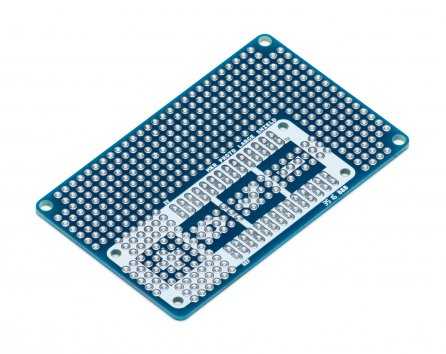
Sie benötigen mehr Platz für Ihr MKR Proto Shield? Das MKR Proto Large Shield passt mit den mitgelieferten female/male Headers auf Ihr MKR Board und ermöglicht es Ihnen, es mit den Befestigungslöchern überall zu befestigen. Diese Abschirmung bietet eine größere Prototyping Fläche mit mehr als 300 Lötstellen und macht die Verbindung von Komponenten mit Ihrer Platine dank der Aufschrift, die die Position der MKR Platinenpins anzeigt, besonders einfach. Technische Spezifikationen Digital I/O Pins 21 PWM Digital I/O Pins depending on the board Analog Input Pins 7 Analog Output Pins depending on the board DC Current per I/O Pin depending on the board DC Current for 3.3V Pin depending on the board DC Current for 5V Pin depending on the board Lenght 80 mm Width 50 mm Weight 19 gr
Sofort verfügbar, Lieferzeit: 1-2 Tage
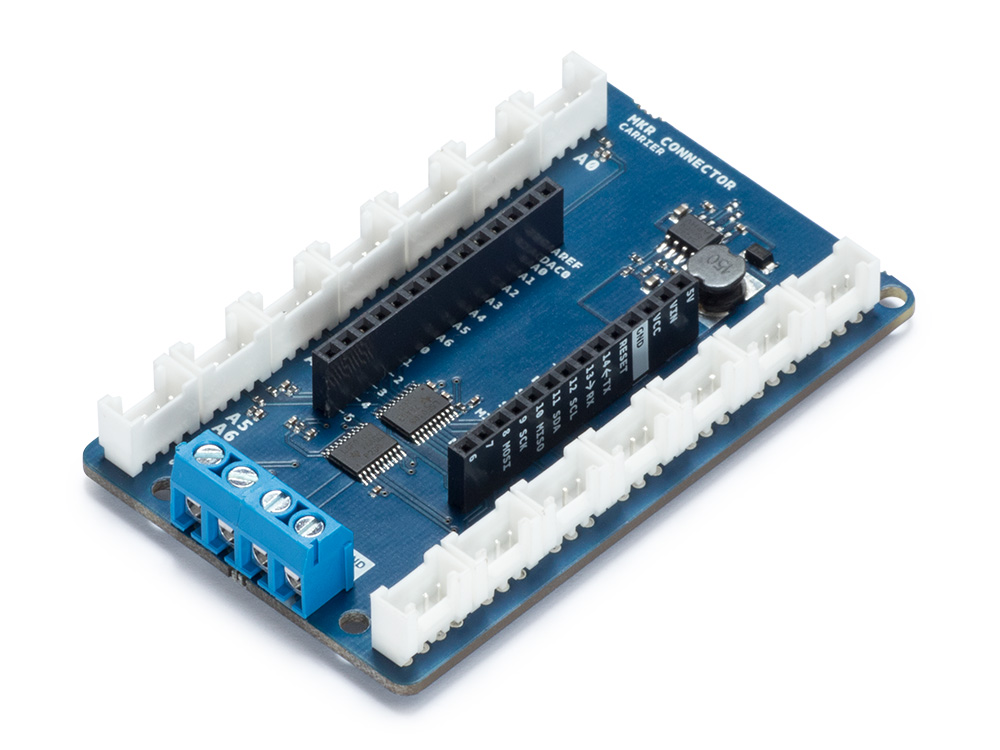
Ihr Arduino MKR Board wird kompatibel zu Seeed Grove! Möchten Sie mehrere Seeed Studio Grove Module an Ihr Arduino Board anschließen? Der Arduino MKR Connector Carrier ist der perfekte Begleiter für Arduino MKR Boards und ein Grove Ökosystem. Arduino® MKR Connector Carrier Haben Sie mehrere Komponenten, die Sie an Ihr Projekt anschließen müssen und möchten lieber Steckverbinder statt Löten verwenden? Der Arduino MKR Connector Carrier bietet die Seeed Studio Grove Anschlüsse für Ihr MKR Board. Das MKR Connector Carrier Shield ist ein unverzichtbares Werkzeug für schnelle Prototyping-Aktivitäten. Es ermöglicht den einfachen und schnellen Anschluss von Sensoren mit Grove Steckverbindern. Dieses Shield kann es Ihnen ermöglichen, Anwendungen mit unterschiedlichen IoT Konnektivitäten zu erstellen, indem Sie einfach das MKR Board wechseln und fast keine Änderungen am Code vornehmen müssen. Technische Spezifikationen Interface 14 Grove Connectors Analog Inputs 5 V A0,A1,A2,A3,A4 single grove Analog input (detailed info) A5, A6 double grove Analog input (detailed info) Digital Input/Output 5 V D0,D1,D2,D3,D4 single grove I/O (detailed info) D5,D6 double grove I/O (detailed info) Other Connectors One 5V I2C, One 5V UART input Voltage (screw terminal block) 7V - 16V (Buck Datasheet) Circuit Operating Voltage 3.3V Compatibility MKR
Nicht Lagernd
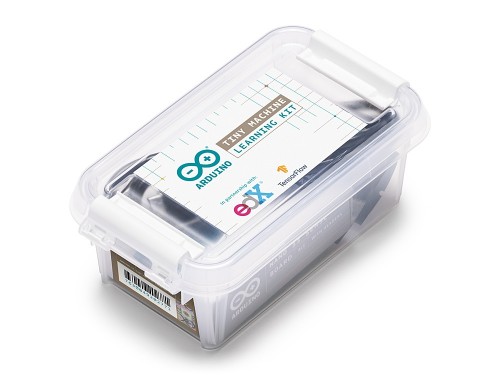
Das Tiny Machine Learning Kit bietet Ihnen alle Werkzeuge, um Ihre Machine Learning-Visionen zum Leben zu erwecken! Sie kombinieren es mit den spannenden Kursen TinyML Applications und Deploying TinyML on Microcontrollers von EdX. Diese sind Teil von Tiny Machine Learning (TinyML). Das Kit besteht aus - einem Arduino Nano 33 BLE Sense - einem leistungsstarken Board, das mit einem Mikrocontroller und einer Vielzahl von Sensoren ausgestattet ist. Das Board kann Bewegung, Beschleunigung, Rotation, Temperatur, Feuchtigkeit, Luftdruck, Geräusche, Gesten, Nähe, Farbe und Lichtintensität erfassen. - einem Kameramodul (OV7675) - einem kundenspezifischen Arduino-Schild, mit dem Sie Ihre Komponenten einfach anschließen und Ihr ganz eigenes, einzigartiges TinyML-Projekt erstellen können. Sie haben die Möglichkeit, praktische ML-Anwendungsfälle sowohl mit klassischen Algorithmen als auch mit den Deep Neural Networks basierend auf ensorFlow Lite Micro zu untersuchen. Das Kit ist für die Nutzung mit dem Harvard / edX "Applications in TinyML course" - Melden Sie sich für den offiziellen zertifizierten Kurs an oder folgen Sie kostenlos den Inhalten für Arduino. (NICHT enthalten)
Nicht Lagernd
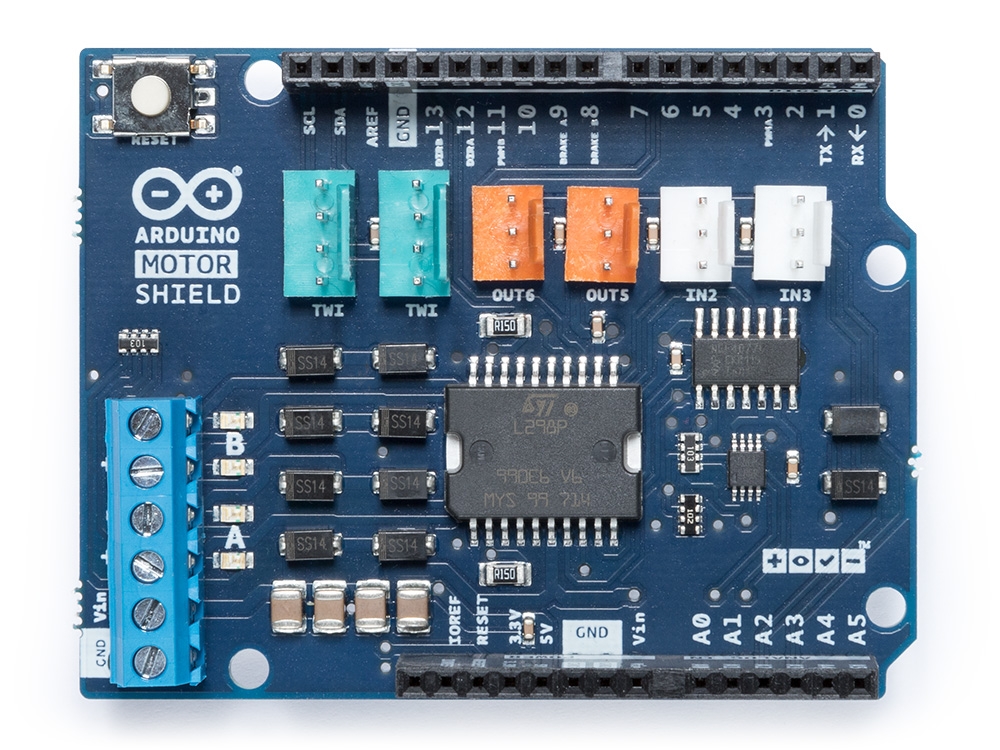
Motoren ansteuern! Das Arduino Motor Shield ermöglicht es Ihrem Arduino, DC- und Schrittmotoren, Relais und Magnete anzutreiben. Arduino® Shield Motor Rev3 Der Arduino Motor Shield basiert auf dem L298 (Datenblatt), einem dualen Vollbrücktreiber zum Antreiben von induktiven Lasten wie Relais, Magneten, DC- und Schrittmotoren. Mit ihm können Sie zwei Gleichstrommotoren mit Ihrem Arduino-Board antreiben und die Geschwindigkeit und Richtung jedes einzelnen unabhängig voneinander steuern. Sie können unter anderem auch die Motorstromaufnahme jedes Motors messen. Der Schild ist TinkerKit-kompatibel, was bedeutet, dass Sie schnell Projekte erstellen können, indem Sie TinkerKit-Module auf das Board stecken.
Nicht Lagernd

Uno The UNO is the best board to get started with electronics and coding. If this is your first experience tinkering with the platform, the UNO is the most robust board you can start playing with. The UNO is the most used and documented board of the whole Arduino family. Produktübersicht Arduino Uno is a microcontroller board based on the ATmega328P (datasheet). It has 14 digital input/output pins (of which 6 can be used as PWM outputs), 6 analog inputs, a 16 MHz quartz crystal, a USB connection, a power jack, an ICSP header and a reset button. It contains everything needed to support the microcontroller; simply connect it to a computer with a USB cable or power it with a AC-to-DC adapter or battery to get started.. You can tinker with your UNO without worring too much about doing something wrong, worst case scenario you can replace the chip for a few dollars and start over again. "Uno" means one in Italian and was chosen to mark the release of Arduino Software (IDE) 1.0. The Uno board and version 1.0 of Arduino Software (IDE) were the reference versions of Arduino, now evolved to newer releases. The Uno board is the first in a series of USB Arduino boards, and the reference model for the Arduino platform; for an extensive list of current, past or outdated boards see the Arduino index of boards. Technische Spezifikationen Microcontroller ATmega328P Operating Voltage 5V Input Voltage (recommended) 7-12V Input Voltage (limit) 6-20V Digital I/O Pins 14 (of which 6 provide PWM output) PWM Digital I/O Pins 6 Analog Input Pins 6 DC Current per I/O Pin 20 mA DC Current for 3.3V Pin 50 mA Flash Memory 32 KB (ATmega328P) of which 0.5 KB used by bootloader SRAM 2 KB (ATmega328P) EEPROM 1 KB (ATmega328P) Clock Speed 16 MHz LED_BUILTIN 13 Length 68.6 mm Width 53.4 mm Weight 25 g
Sofort verfügbar, Lieferzeit: 1-2 Tage

Learn electronics and get started with programming in your classroom step-by-step. No experience necessary. LESSONS Getting Started ( 30 mins). In this lesson the students get familiar with the kit´s material. Learn about electrical safety, how to setup the software and create their first program. Lesson 1 - Electricity Fundamentals (90 mins). In this lesson the students explore some of the basic concepts of electricity and build their first simple circuit while learning about the components that make up the circuit. Lesson 2 - Ohm's Law ( 90 mins). The students explore one of the physical laws that determine how electricity behaves in a circuit: Ohm's Law . They will learn, by building, the difference between parallel and series circuits and will investigate how electrical measurements behave using a multimeter as a tool. Lesson 3 - Traffic Signals (90 mins). In this lesson, students are introduced to the Arduino Software (IDE) and program their first light circuit that controls how the circuit operates. Lesson 4 - Dimmer Switch (90 mins). The students learn about the potentiometer and how they can be used manually to control a circuit. As a result, they will build an LED circuit where the Arduino board will control the brightness of the LEDs based on the position of the potentiometer. As the students code their circuit they will be introduced to concepts such as variables, conditional statements and serial communication. Lesson 5 - Project Holiday Lights ( 90 mins). The students will complete an open-ended project to design, build and program their own holiday light circuit. The project must follow the project's objectives, criterias and constraints. Lesson 6 - Sports Robot ( 90 mins). In this lesson, the students will learn how to use a servo motor to create a simple sports robot. They will program the robot to hit, kick or throw a ball. Lesson 7 - Windshield wipers (90 mins). This lesson introduces new programming concepts to the students such as nested conditionals, switch-case structures, and loops. The students learn the new concepts by programming and building a windshield wiper circuit. Lesson 8 - Musical Keyboard ( 90 mins). In this lesson, students learn about piezo buzzers and how to produce different sounds, tones and music. With that understanding, the student will build and code a musical keyboard. Lesson 9 - Light Wave Radar (90 mins). Students will use their Arduino board and a phototransistor to measure the intensity of the light and will learn the basic principle about how information is transmitted through light waves. Lesson 10 - Project Greenhouse Control System (180 mins). The students will complete an open-ended project to design, build and program a climate-control system for a greenhouse. The project must follow the project's objectives, criterias and constraints. ABOUT Teach middle school students the basics of programming, coding, and electronics. No prior knowledge or experience is necessary as the kits guide you through step-by-step, you are well-supported with teacher guides, and lessons can be paced according to your students’ abilities. You can integrate the kit throughout the curriculum, giving your students the opportunity to become confident in programming and electronics with guided sessions and open experimentation. You’ll also be teaching them vital 21st-century skills such as collaboration and problem-solving. The Arduino Education Starter Kit contains all the hardware and software you need for eight students (in groups of 2). You get step-by-step-lessons, teacher notes, exercises, and for a complete and in-depth class experience there’s also extra optional resources including activities, concepts, history, and interesting facts. The online platform contains the teacher content, nine 90-minute lessons, and two open-ended group projects that teach students coding and electronics. Each lesson builds off the previous one, giving students a further opportunity to apply the skills and concepts they have already learned. Students also get an engineering logbook that they complete as they work through the lessons. The beginning of each lesson provides an overview, estimated completion times, and learning objectives. Throughout each lesson, there are teacher notes and information that help the lesson go smoothly. Extension ideas are provided at the end of each lesson. WHAT'S IN THE KIT? The kit comes with several parts and components that students will use to build circuits as they complete lessons and projects throughout the course. Here is a brief description of what is included in the kit: Access code to exclusive online content including teachers’ guidance notes, step-by-step lessons and extra materials such as resources, invention spotlights and PDF logbooks for students and teachers. 4 Arduino UNO rev 3 4 Starter Kit mounting base Easy-to-assemble plastic base 4 Battery Snap 9v 8 Batteries 9v 4 Breadboard 400 points 4 Capacitor – 100uF 4 Female-male Jumper Wires (red) 4 Female-male Jumper Wires (black) 20 LEDs (red) 20 LEDs (green) 20 LEDs (yellow) 20 LEDs (blue) 4 Multimeters 4 Piezo Buzzer [PKM17EPP-4001-B0] 4 Phototransistors 8 Potentiometer 10kOhms 20 Push Button 4 Resistors - 1 kOhms 20 Resistors - 10 kOhms 20 Resistors - 220 Ohms 20 Resistors - 560 Ohms 70 Jumper Wires 4 Stranded jumper wires (red) 4 Servo Motor 4 Temperature sensor [TMP36] 4 USB Cable 12 M 3 Screw 12 M3 Bolts
Sofort verfügbar, Lieferzeit: 1-2 Tage

Mit dem Oplà IoT Kit können Geräte zu Hause oder am Arbeitsplatz mit einem Netzwerk verbunden werden. Es wird komplett mit 8 Internet-of-Things-Projekten zum Selbstbau geliefert, die Ihnen zeigen, wie Sie Geräte des täglichen Lebens in "intelligente Geräte" verwandeln und maßgeschneiderte vernetzte Geräte bauen, die mit Ihrem Mobiltelefon gesteuert werden können. Fernbedienbare Lampen - ändern Sie Farbe, Lichtmodi und schalten Sie sie über Ihr Handy ein/aus Persönliche Wetterstation - Aufzeichnung und Überwachung der lokalen Wetterbedingungen Hausalarm - Bewegungen erkennen und Warnungen auslösen Sonnensystem-Tracker - rufen Sie Daten von Planeten und Monden im Sonnensystem ab Bestandskontrolle - Warenein- und -ausgänge verfolgen Intelligenter Garten - überwachen und steuern Sie die Umgebung für Ihre Pflanzen Thermostatregelung - intelligente Steuerung von Heiz- und Kühlsystemen Thinking About You - Nachrichten zwischen dem Oplà und der Arduino IoT Cloud sendenFür fortgeschrittene Benutzer bietet das Kit die Möglichkeit, eigene vernetzte Geräte und IoT-Anwendungen zu erstellen, da die offene programmierbare Plattform die optimale Steuerung ermöglicht.Die Oplà-Einheit fungiert als physische Schnittstelle zur Arduino IoT Cloud und bietet Ihnen über die Arduino IoT Remote-App die vollständige Kontrolle. Konfigurieren und verwalten Sie alle Einstellungen über die Arduino IoT Cloud, mit einfach zu erstellenden Dashboards, die Echtzeit-Messwerte von Ihren intelligenten Geräten zu Hause oder am Arbeitsplatz liefern. Das Anpassen von Einstellungen, das Ein- und Ausschalten von Geräten, die Bewässerung von Pflanzen usw. kann mit der Arduino IoT Remote App von unterwegs aus gesteuert werden.Mit dem Oplà IoT Kit haben Sie Zugriff auf einen 12-monatigen* kostenfreien Arduino Create Maker Plan - das Premium-Abonnement für unsere Online-Codierplattform. Sie profitieren von unbegrenzter Kompilierzeit und allen anderen Premium-Funktionen. *Um das kostenlose 12-Monats-Abonnement zu aktivieren, ist die Eingabe einer Kreditkartennummer erforderlich (es fallen keine Kosten an). Inhalt: Das Kit enthält: MKR IoT Carrier, entwickelt für dieses Kit, einschließlich: - Rundes OLED-Display - Fünf kapazitive Touch-Tasten - On-board Sensoren (Temperatur, Feuchtigkeit, Druck und Licht) - Zwei 24-V-Relais - SD-Kartenhalter - Plug-and-Play-Anschlüsse für verschiedene Sensoren - RGBC, Gesten und Annäherung - IMU - 18650 Li-Ion-Akkuhalterung (Akku nicht enthalten) - Fünf RGB-LEDs Arduino MKR WiFi 1010 Kunststoff-Gehäuse Micro-USB-Kabel Feuchte-Sensor PIR-Sensor Plug-and-play-Kabel für alle Sensoren Zugang zu einer Online-Plattform mit allen Anleitungen, Informationen und Aktivitäten, die Sie für den Zusammenbau und das Hinzufügen von Vernetzungen zu Ihrem Gerät benötigen: 8 sofort einsatzbereite, verbundene Projekte 2 Anleitungen zum Kennenlernen des Internets der Dinge Software: Der im Kit enthaltene Arduino Create Maker Plan bietet unbegrenzte Kompilierzeit und erweiterten Zugriff auf alle Funktionen der Arduino IoT Cloud, so dass die Benutzer mehr Sketche speichern können, die Anzahl der Objekte erhöhen und Unterstützung für Boards von Drittanbietern und LoRa-Geräte erhalten.Das Oplà IoT Kit enthält einen speziellen Code, mit dem Sie 12 Monate des Create Maker Plans kostenlos in Anspruch nehmen können. Um den Code einzulösen, gehen Sie einfach zu den Create Plans, wählen Sie den Maker Plan und fügen Sie dann den Code in das dafür vorgesehene Feld an der Kasse ein. Sie werden aufgefordert, Ihre Rechnungsdaten und Ihre Bank-/Kreditkartendaten anzugeben - bei Verwendung des Codes werden Ihnen keine Kosten in Rechnung gestellt*. *Nach Ablauf der 12 Monate kostenlosen Zugangs verlängert sich Ihr Abonnement automatisch zu einer Gebühr von 5,99 US-Dollar pro Monat (zzgl. örtlich geltender Umsatzsteuer), bis es gekündigt wird. Wenn Sie das Create Maker Plan-Abonnement nicht fortsetzen möchten, können Sie die Verlängerung jederzeit kündigen.
Nicht Lagernd

UNO Shield auf MKR Boards! Montieren Sie einfach Ihren MKR1000 an diesem neuen Adapter und stecken Sie einen Ihrer UNO Shields ein! Arduino® MKR2UNO Mit dem MKR2UNO Adapter können Sie Ihr Arduino UNO Formfaktor basiertes Projekt ohne großen Aufwand in ein MKR basiertes Projekt verwandeln! So können Sie Ihr Projekt mit einem leistungsstarken Board mit integriertem LiPo-Ladegerät aufwerten. Bitte beachten Sie, dass der MKR2UNO-Adapter derzeit nur mit dem MKR1000 ohne Header kompatibel ist. Technische Spezifikationen Operating Voltage 3.3V Input Voltage (recommended) 7-12V Input Voltage (limit) 6-16V Analog Input Pins 6 Analog Output Pins 1 Digital I/O Pins 14 DC Current for 3.3V Pin 700 mA DC Current for 5V Pin 700 mA Length 68.6 mm Width 53.4 mm Weight 24 g
Sofort verfügbar, Lieferzeit: 1-2 Tage
Der Primo Core ist der kleine Bruder des Primo mit einem Nordic nRF52 Prozessor. Der Primo Core ist eine Low-Power Version des Primo auf Münzgröße, ideal für Wearables. Der Primo Core ist ein kompaktes Bluetooth-Gerät, mit einem Nordic nrf52832 Chip und mit Motion- und Umweltsensoren. Der geringe Stromverbrauch ermöglicht es, den Primo-Kern mit einer Knopfzellenbatterie mit Strom zu versorgen. Der Arduino Primo Kern kann auf einem Breakout-Board montiert werden, um seine Funktionalität zu erweitern, das sogenannte Alice Pad.
Sofort verfügbar, Lieferzeit: 1-2 Tage

Der Arduino GIGA R1 WiFi wurde für ambitionierte Maker entwickelt. Es bietet die Möglichkei für Gamer, Künstler, Sounddesigner und jeden, der mit großen Ideen und kleinem Budget in die Tech-Welt einzusteigen - weil es fortschrittliche Funktionen in ein handliches Board packt, mit dem gleichen Formfaktor wie die beliebten Mega und Due. Funktionalität des Boards: Mikrocontroller (STM32H747XI): Dieser Dual-Core-Mikrocontroller mit 32 Bits ermöglicht es Ihnen, zwei Prozessoren miteinander kommunizieren zu lassen (einen Cortex®-M7 mit 480 MHz und einen Cortex®-M4 mit 240 MHz). Sie können sogar Micropython auf dem einen und Arduino auf dem anderen ausführen. Drahtlose Kommunikation (Murata 1DX): Egal, ob Sie Wi-Fi® oder Bluetooth® bevorzugen, der GIGA R1 WiFi bietet Ihnen alles. Sie können sich sogar schnell mit der Arduino IoT Cloud verbinden und Ihr Projekt aus der Ferne verfolgen. Und wenn Sie sich Sorgen um die Sicherheit der Kommunikation machen, hat der ATECC608A alles unter Kontrolle. Hardware-Anschlüsse und Kommunikation: In Anlehnung an den Arduino Mega und den Arduino Due verfügt der GIGA R1 WiFi über 4 UARTs (serielle Hardware-Ports), 3 I2C-Ports (1 mehr als bei den Vorgängern), 2 SPI-Ports (1 mehr als bei den Vorgängern), 1 FDCAN. GPIOs und zusätzliche Pins: Es sollte der gleiche Formfaktor des Mega und des Due beibehalten werden, so dass Sie Ihre kundenspezifischen Shields leicht an das GIGA R1 WiFi anpassen können (denken Sie aber daran, dass dieses Board mit 3,3V arbeitet!), und wir haben zusätzliche Header hinzugefügt, um auf zusätzliche Pins zuzugreifen, so dass die Gesamtzahl der GPIO-Pins 76 beträgt, und das Beste daran ist, dass Sie von unten darauf zugreifen können, so dass Sie Ihr Projekt so belassen können, wie es ist, und einfach darüber nachdenken, wie Sie es erweitern können. Außerdem haben wir zwei neue Pins hinzugefügt: einen VRTC, an den man eine Batterie anschließen kann, um die RTC weiterlaufen zu lassen, während das Board ausgeschaltet ist, und einen OFF-Pin, mit dem man das Board abschalten kann. Steckverbinder: Das GIGA R1 WiFi hat zusätzliche Anschlüsse auf dem Board, die die Erstellung Ihres Projekts ohne zusätzliche Hardware erleichtern. Dieses Board hat: • USB-A-Anschluss für den Anschluss von USB-Sticks, anderen Massenspeichern und HID-Geräten wie Tastatur oder Maus. • 3,5-mm-Eingangs-/Ausgangsbuchse für den Anschluss an DAC0, DAC1 und A7. • USB-C® zur Stromversorgung und Programmierung des Boards sowie zur Simulation eines HID-Geräts wie Maus oder Tastatur. • Jtag-Anschluss, 2x5 1,27mm. • 20-poliger Arducam-Kamerastecker. Unterstützung höherer Spannungen: Im Vergleich zu seinen Vorgängern, die bis zu 12 Volt unterstützen, kann das GIGA R1 WiFi einen Bereich von 6 bis 24 Volt verarbeiten.
Sofort verfügbar, Lieferzeit: 1-2 Tage

Der Primo ist der erste Arduino-Board mit einem Nordic nRF52 Prozessor mit WiFi gekennzeichnet. Das Arduino Primo kombiniert die Rechenleistung aus dem Nordic nRF52 Prozessor, einem Espressif ESP8266 für WiFi, sowie mehrere On-Board-Sensoren und ein Batterieladegerät . Die nRF52 umfasst NFC (Near Field Communication) und Bluetooth Smart. Die Sensoren umfassen eine On-Board-Taste, LED und Infrarot-Empfänger und Sender. Das Arduino Primo Core ist in Zusammenarbeit mit Nordic Semiconductor für den Bereich IoT entwickelt worden und ist durch seinen geringen Stromverbrauch und der Bluetoothfähigkeit ideal für Wearables-Projekte geeignet. Der verwendete Mikrocontroller ist ein nRF52832. Dieser wird auch auf dem Arduino Primo verwendet. Spezifikationen: 10 digitale Ein- / Ausgangspins 10 PWM (alle digitalen Pins) 8 analoge Pins (von D0 bis D7) Beschleunigungsmesser und Gyroskop Temperatur- und Feuchtigkeitssensor RGB Led SWD-Anschluss (zur Programmierung des Boards über einen externen Programmer) Ein Knopfzellen-Batteriehalter BLE-Schnittstelle LED NFC-Anschluss (zur Verwendung einer externen NFC-Antenne) Reset-Tasten (zum Zurücksetzen des Mikrocontrollers) Ein / Aus-Schalter für die Stromversorgung Dokumente: Anleitung Arduino PRIMO CORE Schematik WIFI MICROCONTROLLER Processor ESP8266 Architecture Tensilica Xtensa LX106 Operating Voltage 3.3 V Flash Memory 4 MB RAM 8 MB instruction, 12 MB data Clock Speed 80 MHz WiFi 802.11 b/g/n 2.4 GHz Wake up time < 2ms ARDUINO MICROCONTROLLER Microcontroller Nordic nRF52832 Architecture ARM Cortex-M4F Operating Voltage 3.3 V Flash memory 512 KB SRAM 64 KB Clock Speed 64 MHz Analog I/O Pins 6 + 1 DAC DC Current per I/O Pins 7 mA Bluetooth Smart Up to +4 dBm output power, -96 dBm sensitivity Other features PDM interface, AES HW enc, NFC tag SERVICE MICROCONTROLLER Processor STM32F103R8T6 Architecture ARM Cortex-M3 Operating Voltage 2.0 to 3.6 V Flash Memory 64 KB SRAM 20 KB Clock Speed up to 72 MHz Main Features USB/Uart converter, CMSIS-DAP, GPIO expander, Board power management, IrDA GENERAL Input Voltage 5 V Digital I/O Pins 20 PWM Output 3 Power Consumption 87 mA PCB Size 53 x 68.5 mm Weight 34 g Product Code A000135
Sofort verfügbar, Lieferzeit: 1-2 Tage

The ease of use of a Nano board with the addition of secure IoT and BT connectivity. This small, robust and powerful board has WiFi and Bluetooth connectivity that combined with its low power architecture makes it a practical and cost effective solution for your connected projects. Arduino Nano 33 IoT is fully compatible with the Arduino IoT Cloud and supports full TLS secure transport: the ATECC608A cryptochip stores the cryptographic keys in hardware, offering a very high level of security for this class of products. The integration with the Arduino IoT Cloud offers also a very efficient way of setting up online dashboards with little coding and minimal effort. In the same iconic size of the Arduino Nano, the Arduino Nano 33 IoT hosts an Arm Cortex-M0+ SAMD21 processor, a WiFi and Bluetooth module based on ESP32, a 6 axis Inertial Measurement Unit (IMU) and a crypto chip which can securely store certificates and pre shared keys. The board can either be used in a breadboard (when mounting pin headers), or as a SMT module, directly soldering it via the castellated pads.
Sofort verfügbar, Lieferzeit: 1-2 Tage

Why should you buy this product? – It’s the only RP2040 board with connectivity. – It’s the only RP2040 board in the well-known and very popular Nano form factor with castellated pads. – It’s the most versatile RP2040 board because of the additional features - 6-axis IMU, microphone, RGB LED etc – It’s a powerful Arduino board for makers - more RAM and dual-core, allowing new projects – Its IMU has machine learning capabilities, thus additional detection algorithms – Microphone to make voice-enabled projects – The ESP32 core on-board can be used as co-processor
Sofort verfügbar, Lieferzeit: 1-2 Tage

Der Arduino Yun Mini verwendet den Mikrocontroller ATmega32u4 sowie die SoC-(System on Chip)-CPU QCA MIPS 24K. Der Yun Mini besitzt zudem integriertes Wireless LAN. Funktionen Arduino? Yun Mini: Qualcomm Atheros-CPU OpenWRT WLAN (IEEE802.11b/g/n bis 150 Mbit/s 1x1 2,4 GHz) 20 digitale E/A-Stifte (7, die als PWM-Ausgänge verwendet werden können; 12, die als analoge Eingänge verwendet werden können) Quarzoszillator, 16 MHz Micro-USB-Steckverbinder ICSP-Stiftsockel 2 Reset-Tasten 1 Benutzertaste 5 V Betriebsspannung 5 V Eingangsspannung 16 MHz Taktrate 64 MB RAM DDR2 (von Linux-Prozessor) 16 MB Flash-Speicher (von Linux-Prozessor)
Sofort verfügbar, Lieferzeit: 1-2 Tage

Prototyping! Mit dem Prototyping Shield machen Sie Ihre Projekte felsenfest. Es macht es Ihnen leicht, kundenspezifische Schaltungen und Lötelektronik direkt darauf zu entwerfen. Arduino® Proto Shield Der ProtoShield macht es Ihnen leicht, eigene Schaltungen zu entwerfen. Sie können TH- oder SMD-ICs einfach auf dem Prototyping-Bereich löten, um sie mit Ihrem Arduino-Board zu testen. Der SMD-Bereich ist für maximal 24 Pins SOIC integrierte Schaltung ausgelegt und der TH-Bereich enthält viel Platz für die benötigten Komponenten rund um Ihr Projekt. Sie können sogar eine Mini-Breadboard (nicht im Lieferumfang enthalten) auf den Protobereich kleben, um einen lötfreien Betrieb zu ermöglichen. Der Proto-Bereich umfasst auch zwei Stromleitungen (IOREF und GND), zwei LED-Pads und SPI-Signale Breakout-Pads für Boards mit SPI nur auf dem ICSP-Header wie Zero. Hauptmerkmale: - 1.0 Arduino Pinbelegung - 1 ICSP-Steckverbinder-Footprint - 2 LEDs und Widerstandsfläche - IOREF und GND Stromleitungen - SPI-Signalpads - 24-Pin SMD-Footprint (50 mils pitch)
Sofort verfügbar, Lieferzeit: 1-2 Tage
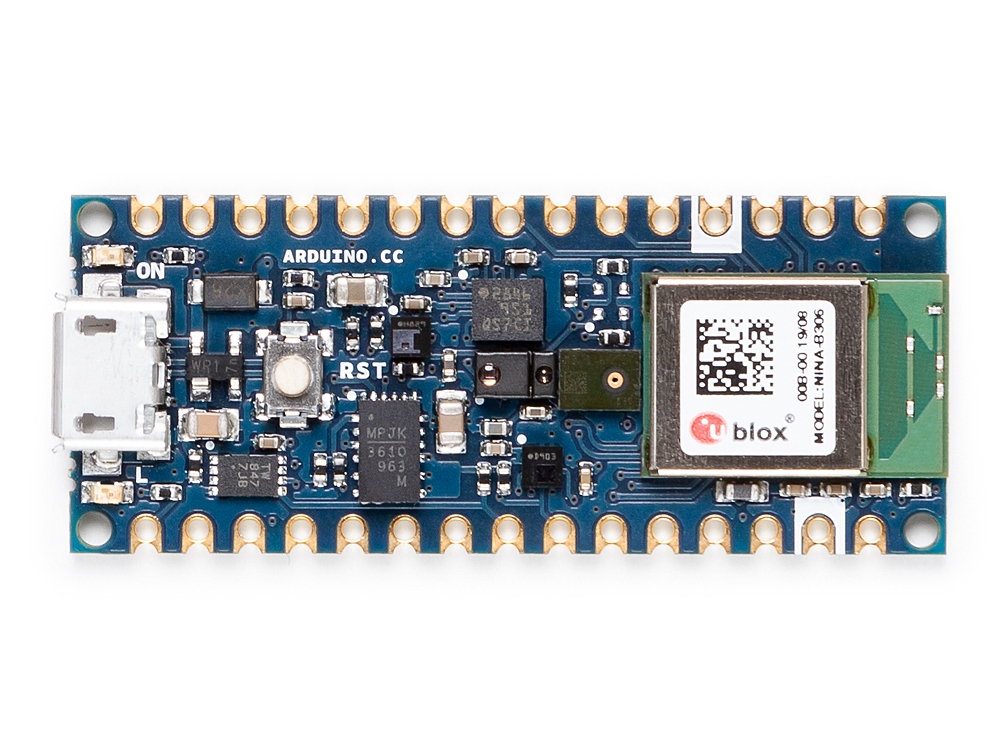
Designed for short range BT interactions and power savvy projects. This compact and reliable Nano board is built around the NINA B306 module, based on Nordic nRF 52840 and containing a powerful Cortex M4F. Its architecture, fully compatible with Arduino IDE Online and Offline, has a 9 axis Inertial Measurement Unit (IMU) and a reduced power consumption compared to other same size boards. This allows the design of wearable devices and movement sensing projects that need to communicate to other devices at a close range. Arduino Nano 33 BLE is also ideal for automation projects thanks to the multiprotocol BT 5.0 radio. With headers mounted.
Nicht Lagernd
Inhalt: 4x Projekte vom Arduino Starter Kit 1x Arduino™ Uno Platine Rev3 1xUSB-Kabel 1xSteckplatine 1xDrucktaster 1xPhotowiderstände 1xTemperaturfühler 1xKippschalter 6xLED (rot) 1xPVC-Kabel rot 1xPVC-Kabel schwarz 1xPiezo-Kapsel 7xDioden 22xWiderstände 220 Ohm 7xWiderstände 560 Ohm 7xWiderstände 1 kOhm 7xWiderstände 4,7 kOhm 22xWiderstände 10 kOhm 7xWiderstände 1 MOhm 7xWiderstände 10 MOhm Systemanforderungen: • USB - Port • Windows XP oder besser • Mac OS X 10.5 oder besser • Linux
Sofort verfügbar, Lieferzeit: 1-2 Tage

Mega 2560 The MEGA 2560 is designed for more complex projects. With 54 digital I/O pins, 16 analog inputs and a larger space for your sketch it is the recommended board for 3D printers and robotics projects. This gives your projects plenty of room and opportunities. Produktübersicht The Arduino Mega 2560 is a microcontroller board based on the ATmega2560. It has 54 digital input/output pins (of which 15 can be used as PWM outputs), 16 analog inputs, 4 UARTs (hardware serial ports), a 16 MHz crystal oscillator, a USB connection, a power jack, an ICSP header, and a reset button. It contains everything needed to support the microcontroller; simply connect it to a computer with a USB cable or power it with a AC-to-DC adapter or battery to get started. The Mega 2560 board is compatible with most shields designed for the Uno and the former boards Duemilanove or Diecimila. The Mega 2560 is an update to the Arduino Mega, which it replaces. Technische Spezifikationen Microcontroller ATmega2560 Operating Voltage 5V Input Voltage (recommended) 7-12V Input Voltage (limit) 6-20V Digital I/O Pins 54 (of which 15 provide PWM output) Analog Input Pins 16 DC Current per I/O Pin 20 mA DC Current for 3.3V Pin 50 mA Flash Memory 256 KB of which 8 KB used by bootloader SRAM 8 KB EEPROM 4 KB Clock Speed 16 MHz LED_BUILTIN 13 Length 101.52 mm Width 53.3 mm Weight 37 g
Sofort verfügbar, Lieferzeit: 1-2 Tage
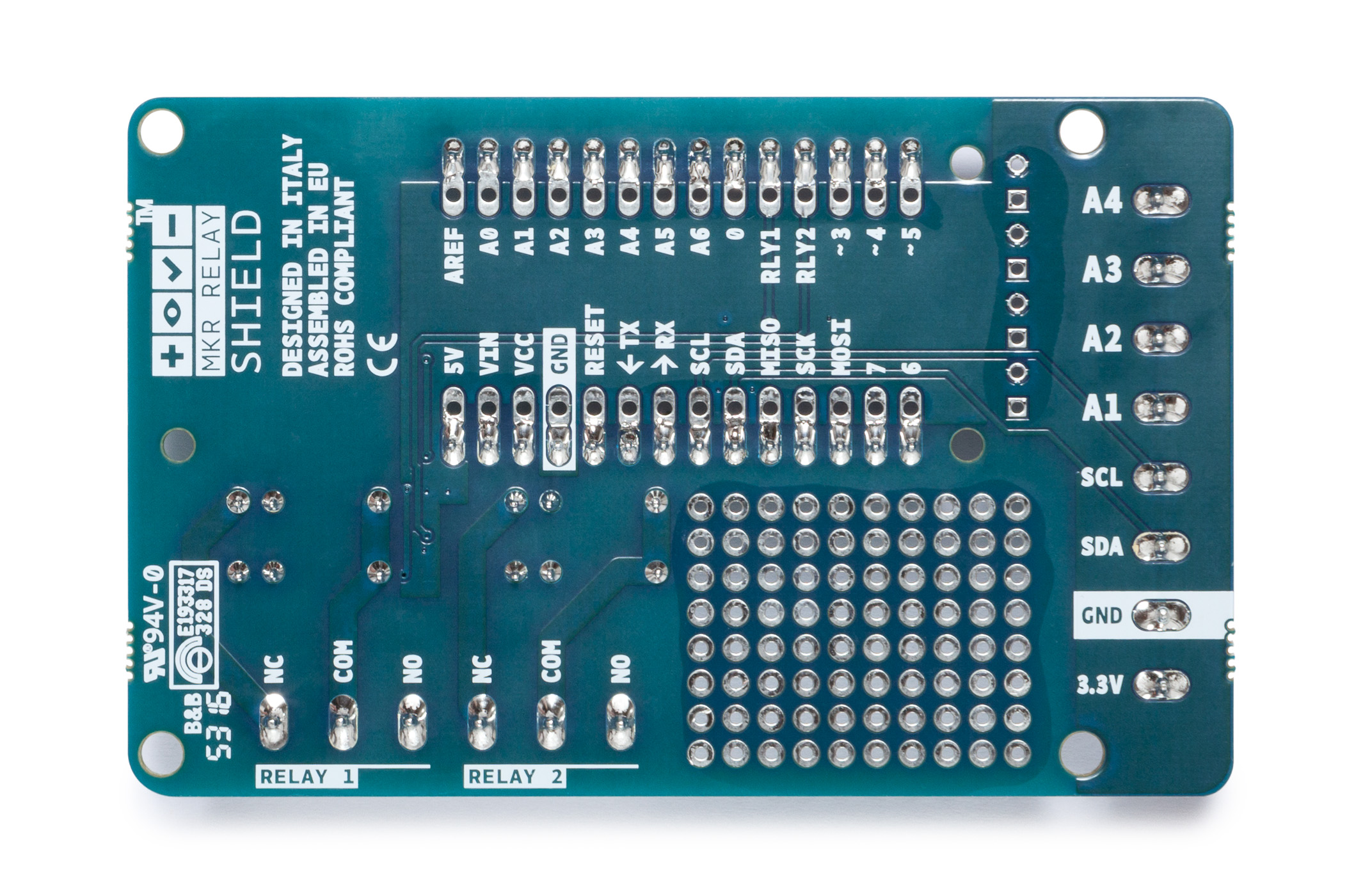
Relais! Das MKR Relay Proto Shield ermöglicht es Ihnen, Relais einfach mit Ihrem MKR Board zu steuern. Das Shield bietet zwei On-Board-Relais und einen kleinen Prototyping-Bereich, wenn Sie Ihrem Projekt eine weitere Komponente hinzufügen möchten. Arduino® MKR Relay Proto Das MKR Relay Proto Shield ermöglicht es Ihnen, auf einfache Weise Relais zu Ihrem MKR-Board-basierten Projekt hinzuzufügen. Das Shield stellt zwei Relais zur Verfügung, die RELAY1 und RELAY2 genannt werden und von Pin 1 bzw. Pin 2 gesteuert werden. Das Shield ermöglicht auch einen einfachen Anschluss über Schraubklemmen an A1 bis A4. Technische Spezifikationen Operating voltage 3.3V (supplied from the host board) Two relays with NO, COM and NC connections Works with battery powered board 8 positions screw terminal blocks for easy connections with A1 to A4 Analog input, SCL SDA for I2C, GND and 3.3V output 6 positions screw terminal blocks (NO, COM, NC for each relay) Carry current: 2 A Max. operating voltage: 24 VAC, 50 VDC Max. operating current: 1 A Max. switching capacity: 62.50 VA, 30W Proto area
Sofort verfügbar, Lieferzeit: 1-2 Tage

Micro Arduino Micro is the smallest board of the family, easy to integrate it in everyday objects to make them interactive. The Micro is based on the ATmega32U4 microcontroller featuring a built-in USB which makes the Micro recognisable as a mouse or keyboard. Produktübersicht The Micro is a microcontroller board based on the ATmega32U4 (datasheet), developed in conjunction with Adafruit. It has 20 digital input/output pins (of which 7 can be used as PWM outputs and 12 as analog inputs), a 16 MHz crystal oscillator, a micro USB connection, an ICSP header, and a reset button. It contains everything needed to support the microcontroller; simply connect it to a computer with a micro USB cable to get started. It has a form factor that enables it to be easily placed on a breadboard. The Micro board is similar to the Arduino Leonardo in that the ATmega32U4 has built-in USB communication, eliminating the need for a secondary processor. This allows the Micro to appear to a connected computer as a mouse and keyboard, in addition to a virtual (CDC) serial / COM port. It also has other implications for the behavior of the board; these are detailed on the getting started page. Technische Spezifikationen Microcontroller ATmega32U4 Operating Voltage 5V Input Voltage (recommended) 7-12V Input Voltage (limit) 6-20V Digital I/O Pins 20 PWM Channels 7 Analog Input Channels 12 DC Current per I/O Pin 20 mA DC Current for 3.3V Pin 50 mA Flash Memory 32 KB (ATmega32U4) of which 4 KB used by bootloader SRAM 2.5 KB (ATmega32U4) EEPROM 1 KB (ATmega32U4) Clock Speed 16 MHz LED_BUILTIN 13 Length 48 mm Width 18 mm Weight 13 g
Sofort verfügbar, Lieferzeit: 1-2 Tage